



Table of content.
As almatar navigated a period of geopolitical instability in the Middle East, the travel market experienced a noticeable shift in user behavior.
Booking intent declined, users became more hesitant to complete transactions, and drop-offs across the funnel increased. As a result, almatar needed a more strategic approach to stabilize performance and maximize revenue from its existing user base.
Acquisit partnered with almatar’s marketing team to implement an omnichannel lifecycle marketing strategy focused on improving conversion rates, increasing engagement, and driving revenue growth through owned channels as part of a broader performance recovery approach.
Strategy
The strategy focused on repositioning CRM from a supporting channel into a stronger revenue contributor by leveraging user behavior and intent signals across the booking journey.
Rather than relying on one-time campaigns, the approach centered around building a fully automated lifecycle engine, designed to engage users at every stage of their journey.
The strategy focused on three key objectives:
- Recovering lost conversions across the funnel.
- Increasing user engagement and repeat bookings.
- Maximizing revenue from existing traffic.
To achieve this, the lifecycle framework was structured around key user behaviors, allowing almatar to deliver relevant messaging based on intent and timing. High-impact journeys were designed to target users at critical decision points, particularly where drop-offs were most frequent.
At the same time, CRM channels were orchestrated to work together, ensuring consistent communication across push notifications, email, and WhatsApp, increasing the likelihood of conversion.
Execution
Acquisit partnered with almatar’s marketing team on a set of automated journeys across the customer lifecycle.
A strong focus was placed on conversion-driven use cases, particularly abandonment flows across flights and hotels.
At the same time, retention and reactivation journeys were introduced, targeting users who had become inactive over time. These included lapsing and churn prevention flows, ensuring that almatar maintained continuous engagement with its user base.
Significant effort was placed on personalization, ensuring that messaging reflected user behavior, travel intent, and booking context. Incentives such as loyalty points and time-sensitive offers were integrated to create urgency and encourage faster decision-making.
The entire lifecycle system was designed to operate continuously, allowing almatar to engage users dynamically without relying on manual campaign execution.
Results & Impact
The lifecycle transformation strengthened almatar’s ability to convert and retain users during a challenging market period while supporting broader business recovery efforts across channels.
In March 2026, following the activation of CRM journeys and broader optimization efforts, almatar recorded its highest performance levels across both revenue and bookings.
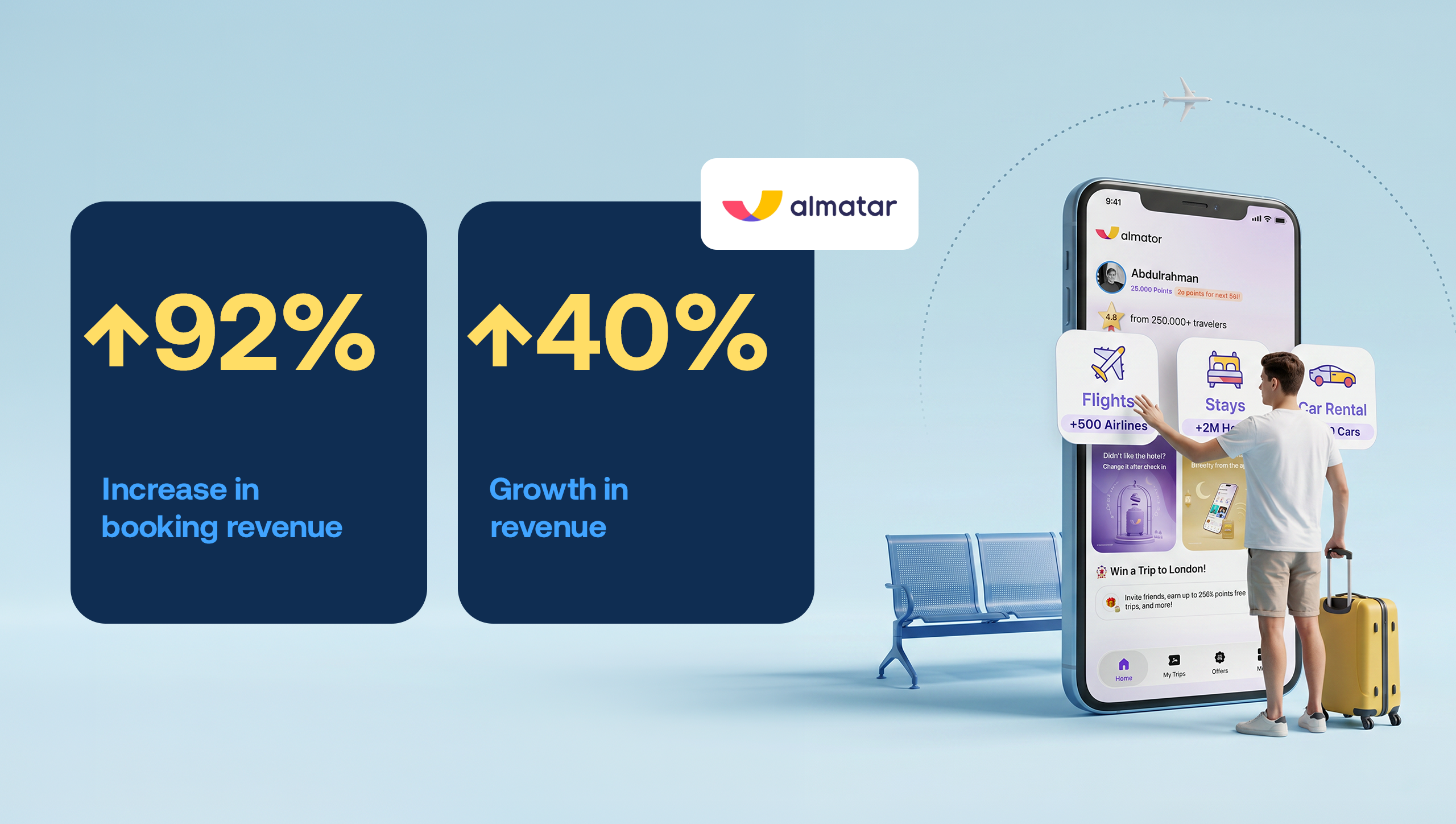
- +92% increase in booking revenue in March compared to February.
- +40% growth in revenue compared to the January baseline.
- +66% increase in total bookings compared to February.
- +24% increase in bookings compared to January.
Beyond overall performance, CRM became a key contributor to business growth:
- CRM journeys contributed a significant share of total booking revenue.
- Retention and winback journeys played a key role in reactivating users and driving repeat bookings.
This uplift demonstrates the effectiveness of a structured lifecycle marketing approach in not only recovering lost demand but also accelerating growth.
Conclusion
By evolving CRM into a fully automated lifecycle engine, almatar moved from reactive campaigns to proactive, behavior-driven engagement. This transformation not only improved conversion and retention but also maximized the value of existing traffic while reducing dependency on paid channels.
Ultimately, it proved that CRM is not just a support function, but a scalable growth engine capable of driving performance even in uncertain market conditions.
Tags:
CRMTable of content.
Share in social:

