



In our previous article, we explored why Generative Engine Optimization (GEO) matters as AI platforms are increasingly shaping brands’ discoverability.
Now the real question is: how can businesses start implementing GEO in practice?
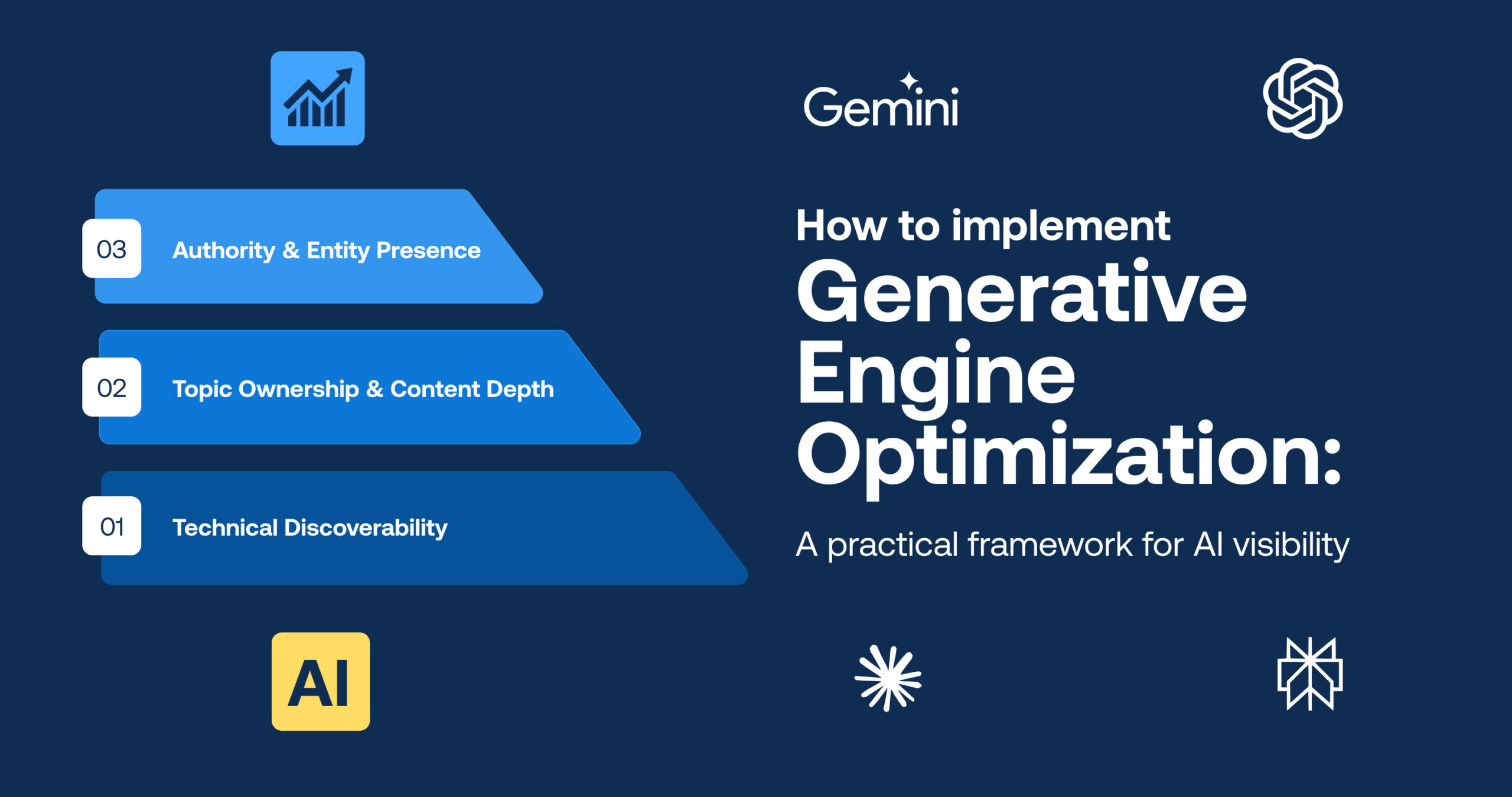
GEO implementation relies on five core pillars, which are structural foundations that determine whether AI engines can discover, understand, and recommend your business.
Ensuring AI can discover and interpret your website
Businesses must ensure they are technically discoverable before optimizing for visibility.
AI platforms like ChatGPT rely on underlying search infrastructure, particularly Bing’s technology. This means that if your website is not properly indexed or rendered on Bing, it may not be visible to AI systems at all.
Step one is to audit your website using Bing Webmaster Tools to confirm that:
- Pages are indexed.
- Content is properly rendered.
- No technical barriers are preventing AI bots from crawling the site.
If AI engines cannot access and understand your pages, no content strategy will compensate for that gap. Technical discoverability is the foundation.
Shifting from keywords to topics
Traditional SEO strategies revolve around short keywords, but GEO requires a different approach.
Instead of asking, “What keyword should we rank for?”, businesses need to ask, “What topics do we want to be known for?”
GEO operates around topics and prompts rather than isolated keywords. Users interact with AI platforms using long and detailed prompts. Hence, businesses must think in terms of topic clusters.
Making it happen involves:
- Identifying core service pillars.
- Generating extensive lists of prompts related to each topic.
- Mapping where and how the brand appears across those prompts.
The shift from keyword targeting to topic ownership changes how content is planned and structured. AI engines evaluate how deeply and comprehensively a business covers a subject.
Building structured depth through topic clustering
Depth and structure play a critical role in GEO content evaluation, so having a single page about a service is not enough.
AI systems are more likely to recognize expertise when a business demonstrates layered coverage of a subject across their website.A strong GEO structure typically looks like this:
- A main topic
- Subtopics that expand on different aspects of that topic
- Further detailed layers that dive deeper into related concerns, use cases, or variations
For example, instead of having one general page about SEO services, a business might have:
- A main SEO page.
- Separate pages for technical SEO, content SEO, and backlinks management.
- Additional supporting articles and resources (case studies, interviews, Q&A etc.)
The more structured and interconnected the content, the more knowledgeable the brand will be perceived.
Strengthening mentions and citations
Mentions and citations are a critical component of GEO: AI engines gather information from multiple sources beyond a company’s own website. These include:
- User reviews
- Reddit discussions
- Social media
- Wikipedia
- Other trusted platforms
Unlike traditional backlink strategies that may sometimes focus on quantity, GEO places significant importance on credibility and relevance. The more a business is referenced across credible, authoritative sources, the more likely AI engines are to recognize it as a trusted entity. Customer experience also plays a direct role. Positive reviews and strong reputation signals increase the likelihood of being recommended.
Establishing a recognizable brand entity presence
Beyond just content and mentions, AI engines must recognize a business as a real, credible entity to cite it, and recognition is built through consistency across platforms: the same brand name, the same positioning, and the same presence across different trusted online channels.
Keep in mind that entity recognition is not built overnight. It develops over time through consistent presence, structured content, and trustworthy signals.
Conclusion
Implementing GEO is not about quick fixes or keyword stuffing, it is about building a structured, credible digital presence that AI engines can discover, understand, and trust.
The process begins with technical discoverability and evolves into topic ownership and structured depth. It is reinforced through mentions, citations, and consistent brand presence across trusted platforms.
GEO requires time, resources, and strategic alignment. As AI-driven discovery continues to shape how users research, discover, and evaluate brands, businesses that invest in these foundations will be better positioned to appear not just as links, but as direct answers.
This article draws on the expertise and insights of Acquisit’s SEO & GEO Operations Manager, Muhaib AbuBaker.
Tags:
GEO
